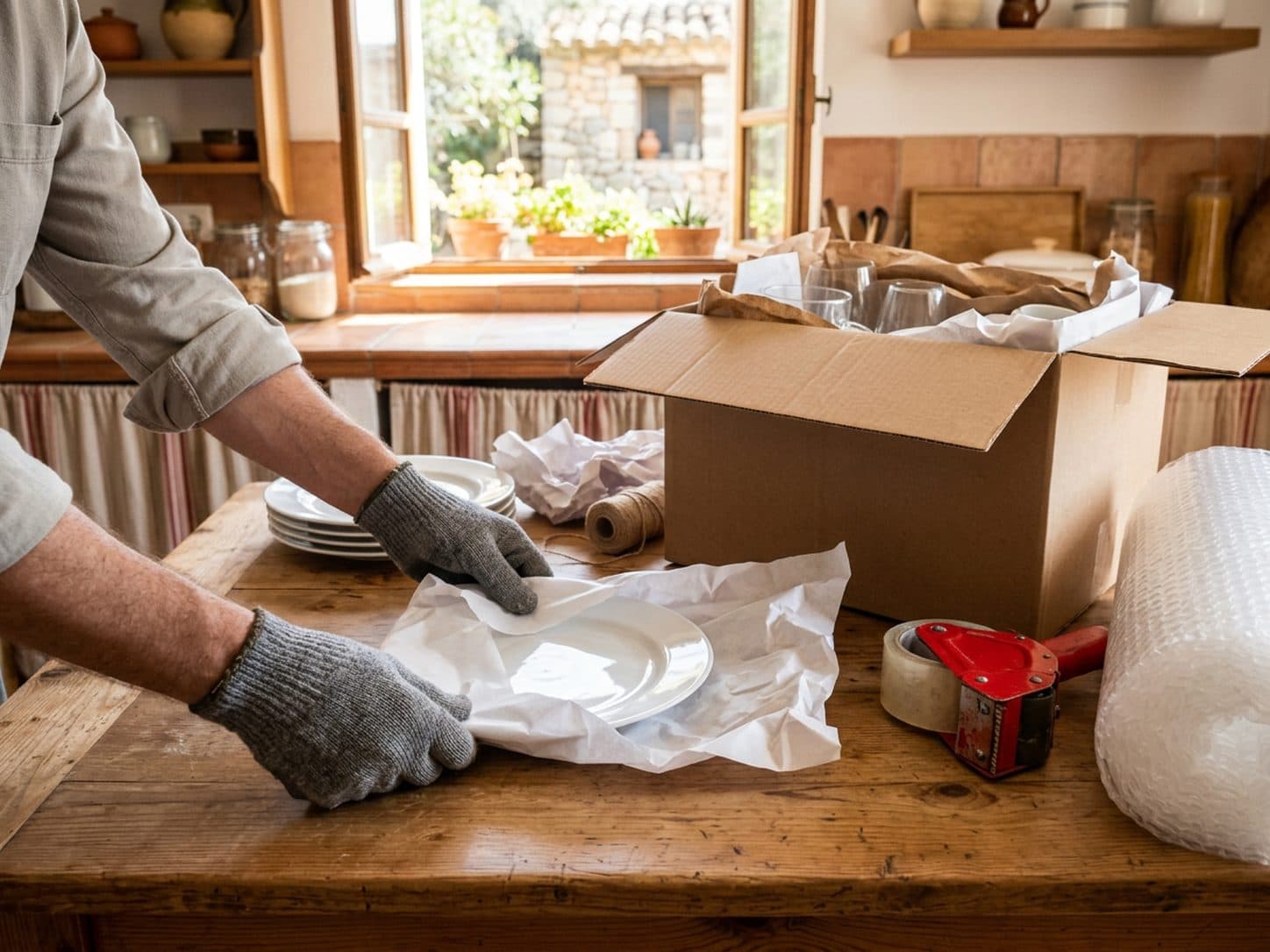
Quick answer: pack the kitchen over several days, not in one evening. Start with what you use least, finish with the kettle and two plates, put heavy items in small boxes and breakables on edge with plenty of paper. If your kitchen is kosher, treat meat, dairy, pareve and Pesach as separate moves: separate boxes, separate labels and separate padding. Everything below is detail on those few rules.
The kitchen is the room that catches people out. It looks small, but it holds more separate objects than any other room in the home: plates, glasses, lids, jars, tins, gadgets and a drawer nobody can explain, most of them fragile, heavy or both. Families that packed a living room in an afternoon often find the kitchen needs two days. This guide covers the order that works, how to wrap each kind of item, what to do about the fridge and the cooker, and, in a section of its own, how to pack a kosher kitchen so nothing gets mixed up on the way.
Plan the kitchen in stages
You still need the kitchen until the last morning, so you cannot empty it all at once. Work backwards from the date of the move.
| When | What to pack or do |
|---|---|
| Three weeks before | Start running down the freezer and pantry. Stop buying in bulk. Pack hosting items you will not need before the move: serving platters, extra glasses, the large pots, holiday dishes. |
| One week before | Pack everything you can live without for seven days: baking tins, the second set of mugs, cookbooks, rarely used appliances, most of the spices. |
| Two days before | Cut down to one plate, one bowl, one cup and one set of cutlery per person. Empty and clean the fridge. Pack the pantry. |
| The night before | Defrost the freezer if it travels with you. Pack the open-first box. Eat from paper plates if you want to save time on dishes. |
| Moving day | Make the last coffee, wash the last cups, pack the kettle. Wipe the empty shelves while the cupboards are bare. |
What to have on hand
- Small and medium sturdy boxes. Avoid large boxes in the kitchen: a large box full of crockery is too heavy to carry safely.
- Plain, unprinted packing paper. Newspaper works for pots, but the ink rubs off on plates and glasses.
- Bubble wrap for the few pieces you cannot replace.
- Tape, markers and sticky labels.
- Dish towels, tea towels and baking sheets as extra padding. You are carrying them anyway.
- Zip bags for small parts such as blender lids, screws and rubber seals.
- A cooler bag for the last food.
Packing item by item
Plates, bowls and platters
Wrap plates in stacks of two or three with a sheet of paper between each, then wrap the stack. Pack them on edge, like records in a rack, rather than flat. A plate standing upright takes bumps along its rim, which is its strongest part, while a flat stack takes them across the face. Put crumpled paper at the bottom and top of the box, and fill any gap so nothing can shift. Bowls nest with paper between them. Large platters go in vertically, with a towel between each.
Glasses and mugs
Wrap each glass separately and push a ball of paper inside, so the rim is not a hollow that can crack under pressure. Pack in a single layer, then add paper, then another layer. For wine glasses, wrap the bowl first and then the stem and base. Mugs are strongest at the body and weakest at the handle, so give every handle its own wrap.
Pots, pans and baking trays
Nest pots with a sheet of paper between each to protect non-stick surfaces, and tape or tuck the lids inside. Heavy cast iron gets a small box of its own. Baking trays stand on edge. Put the heaviest items at the bottom of the box and the lightest on top.
Knives and sharp tools
Wrap each blade separately in thick paper or a folded towel, tape it shut and write sharp on the box in large letters. Keep the box upright. A knife block can travel in its own box, with the knives taped in place.
Small appliances
Use the original boxes if you kept them. If not, wrap each appliance and tape its cord to its body, or bag the cord and tape the bag to it, so the parts stay together. Empty and dry water tanks before packing to avoid smells. Pack glass jugs and carafes separately from the base. Pressurized soda-machine cylinders are worth a question: ask the movers before packing day whether they carry them, because you may need to take yours in your own car, upright and secured.
Pantry, spices and oils
Use up what you can and throw out what is open and stale. Put dry goods in sealed bags and tape the lids of spice jars. Pack glass jars and bottles upright, wrapped, in a box that is filled so they cannot knock together, and double-bag anything with oil or sauce. In an Israeli summer, a closed truck gets very hot, so chocolate, oils and anything perishable should travel with you, not on the truck.
The fridge, the freezer and the cooker
Fridge and freezer. Run the food down over the last two weeks. Defrost the freezer at least a day before the move: it releases more water than you expect, so lay towels on the floor. Wipe everything dry and prop the doors open with a rolled towel so the inside does not smell. Tape the shelves and drawers in place or pack them separately. Keep the fridge upright, and check your manual before plugging it in at the new home, since many manufacturers ask you to let it stand for a few hours first.
Gas and built-in appliances. If your kitchen runs on gas, disconnecting and reconnecting the cooktop is work for a licensed gas technician. Do not leave it for moving day. Agree early who does it at each end, and book it for the same day as the move. The same question applies to a built-in dishwasher or a washing machine that sits in the kitchen: who disconnects the water and drain hoses at the old home, and who reconnects them at the new one? Many movers will move the appliance but not connect it.
Oven and microwave. Take out loose racks and trays and wrap them, and remove the turntable from the microwave. Before you unplug anything, take a photo of how the cables sit at the back. You will thank yourself later.
Packing a kosher kitchen
This is the part that general moving guides skip. When you move a kosher kitchen you are not moving one set of objects but two or three that must stay apart, and sometimes a fourth that has been in storage for months. Questions of halacha belong with your rabbi. What follows is the practical side: boxes, labels and order.
Keep meat and dairy apart from the first box
Choose one color for each category and stick to it: for example red tape for meat, blue for dairy, green for pareve. Put the colored tape on the top and on two sides of every box, and also write the category in words, since a color alone is easy to misread when boxes are stacked in a hallway. Dish racks, drying mats, sink inserts, sponges and dish towels belong to a category too, so pack each one with the set it served. Use separate padding for each category: one roll of paper and one pile of towels per set, so a blue box is never cushioned with a red towel.
If you have a second oven, a second microwave or a dedicated toaster, each one travels with its own set. Tell the movers which boxes are which in writing, with a short list taped inside the front door. The movers carry the boxes, and you decide what goes where.
Pesach dishes and equipment
Pesach sets are usually stored for most of the year, so they are the easiest part of a move: leave them sealed, label them Pesach, meat or Pesach, dairy, and do not open them until the new kitchen is ready. If you are moving in the weeks before Pesach, build the schedule around the holiday, not the other way around. Decide with your rabbi when the Pesach sets come out and when the kitchen is ready for them, and fix the date of the move after that.
The new kitchen before the first meal
If you do not know how the previous occupants kept their kitchen, ask your rabbi what the oven, stovetop, sink and counters need before you use them. Allow time for it, and plan the first days around disposable plates and cutlery. Leave the kitchen boxes sealed until the answer comes, rather than filling cupboards that might need to be emptied again.
Shabbat essentials travel in their own bag
Pack the Shabbat items last and unpack them first: candlesticks, matches or lighter, the hot plate or blech, kiddush cup, challah board and cover, and the Shabbat timer. Keep them in one bag that stays with you. Friday moves are tight, especially in winter when Shabbat begins early. If you can choose, Sunday to Thursday is easier on everyone than a move squeezed in before candle lighting.
Label so the unpacking is fast
Number every box, such as Kitchen 3 of 14, and write three things on it: the room, the contents in a few words, and which cupboard it belongs in. Keep a one-page list of numbers so you can tell at the end whether anything is missing. Put fragile and this side up on the top and sides, not only the top, since boxes get stacked.
Then pack an open-first box and carry it yourself. Put in the kettle, mugs, coffee and tea, two plates and bowls, cutlery, a knife, a can opener, dish soap, a sponge, paper towels, a pot, and the food for the first night. In an observant home, add the Shabbat bag.
Unpacking at the new home
Open the first box and make a cup of tea. Then wipe the inside of every cupboard before anything goes into it, because that is the one time they will be completely empty. Decide which cupboards hold meat, dairy and pareve before the boxes are opened, and unpack category by category. A new kitchen is often smaller or has a different layout than the old one, so keep a spare box or two for the items that turn out not to fit, and sort them later instead of forcing them in.
Who should pack the kitchen?
Many people pack the bedrooms and bookshelves themselves and hand over only the kitchen, because it is the room with the most items and the most ways to lose a glass. If you want help, packing services cover the kitchen with proper paper and boxes, and moving crates are a sturdy alternative to cartons for pots, pans and pantry goods. At the other end, unpacking and home setup puts the boxes in the right rooms and the dishes in the right cupboards.
MovingIL coordinates the move: you deal with one contact, in English, on WhatsApp, and you get one closed price before anything is booked. The packing and carrying are done by independent moving companies we work with. If your kitchen is kosher, say so in the first message and send the list of categories, and we will pass it on to the movers in writing before the date.