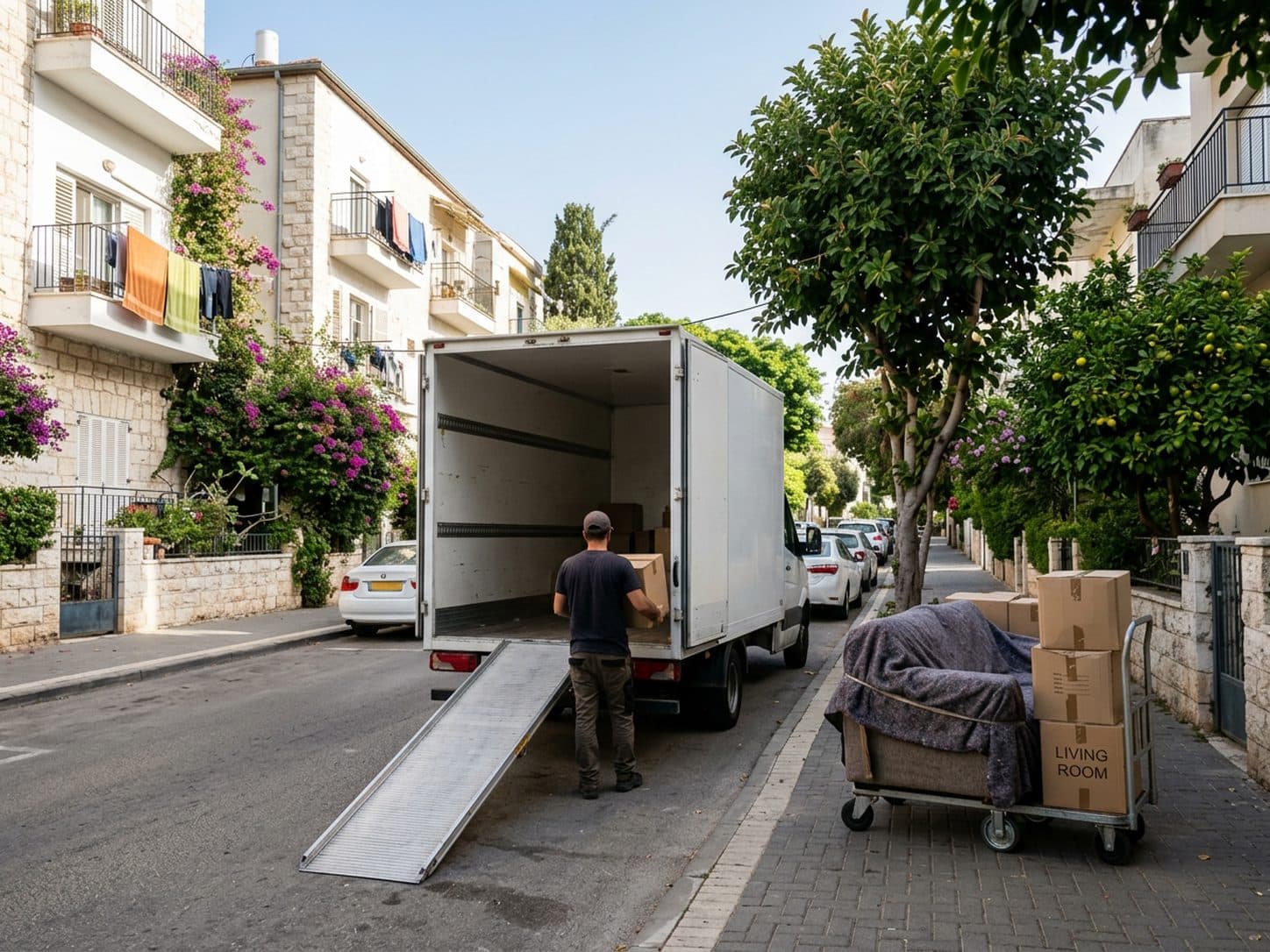
Quick answer: in many Israeli cities a moving truck cannot simply park outside the building for several hours. Depending on the city and the street, you may need approval from the municipality, a cleared stretch of curb, or nothing at all beyond parking legally and briefly. The rules differ by municipality and change over time, so ask your municipality before you book the date. This guide shows what to ask, who to ask, and how to avoid a parking ticket or a delay on moving day.
The moving truck is the one part of a move that you cannot fix on the day. If the packing is behind schedule you can work faster. If the truck cannot get close to the entrance, the movers carry everything farther, the move takes longer, and the neighbors start to complain. In cities where street parking is scarce, a plan for the truck is as important as the plan for the boxes. This guide is general information, not legal advice. We do not list fees or regulations, because each municipality sets its own and they change.
Why the truck needs a plan
A moving truck is long, and it needs room behind it for a ramp or a tail lift. It also stays in one place for hours, not minutes. That is why a spot that works for a delivery van may not work for a move. Double-parking blocks the street, and hazard lights do not make it legal. The result can be a parking ticket and, in the worst case, a tow, as well as annoyed neighbors and movers who have to wait for the road to clear.
What a municipality may offer
There is no single national rule for this. Depending on the city, the street and the date, you may find one of these arrangements:
| Arrangement | What it means | What to ask |
|---|---|---|
| Approval to reserve a stretch of curb | The municipality allows the truck to stand in a marked place for a set time, sometimes with temporary signs. | Who puts up the signs, how far ahead, and what to show on the day. |
| Approval to stand where parking is normally limited | A written permission for the truck on a street with restricted parking or in a loading zone. | The hours it covers and the size of the vehicle it names. |
| No special approval | Ordinary parking rules apply, so the truck must park legally and not block the road. | Whether there is a nearby spot, and for how long it is allowed. |
| Restricted street | A pedestrian street, a narrow or one-way lane, or a steep street that a large truck cannot enter. | A smaller vehicle, and where the load can be transferred. |
Do not assume that what worked at your last address works at the new one. Rules differ not only between cities but sometimes between neighborhoods.
Reading the curb
Israeli curbs are painted, and the colors tell you what is allowed. In general, a red-and-white curb means no parking, a blue-and-white curb means paid parking, with hours and limits shown on the nearby sign, and a plain or gray curb means parking is allowed unless a sign says otherwise. Signs are mostly in Hebrew, and local variations exist, so take a photo and ask someone who reads Hebrew if you are not sure. Do not rely on the color alone when you are planning a truck for several hours.
How to find out what applies at your address
- Ask the movers first. They know what they need: the length of the truck, whether it has a tail lift, and how much space it needs behind it. Ask them what they do in your area.
- Check the municipal website. Some have a page for residents about moving, parking and traffic. Search for the Hebrew phrases אישור חניה להובלה or שמירת מקום חניה להובלה on the site, or ask someone to search for you.
- Call the municipality. Many cities run a 106 hotline, and some have a traffic or parking department. Ask the person on the line which office handles moving trucks.
- Give the facts. The street and building number, the date and the hours, the length of the truck, and whether a crane or lift will be used.
- Ask the follow-up questions. Is approval needed? How many working days ahead? Do I apply or does the moving company? Is there a form? Will the signs be put up for me? What should I show on the day?
If you do not speak Hebrew, you can send a short message through the municipal website or email. Here is a template you can adapt, with the details in brackets:
שלום, אני מבקש/ת לברר אם נדרש אישור חניה זמני למשאית הובלה ברחוב [שם הרחוב] [מספר] בתאריך [תאריך] בין השעות [שעות]. אורך המשאית הוא כ-[אורך] מטר. תודה.
In English: Hello, I would like to ask whether a temporary parking permit is needed for a moving truck at [street and number] on [date] between [hours]. The truck is about [length] meters long. Thank you.
Who applies and who pays
This is the question that gets forgotten. Municipalities differ on who may apply: the resident, the moving company, or either. Agree in writing before the date who applies, who pays if there is a fee, and who will be on site with the document. Put it in the same WhatsApp thread as the date and the price, so everyone has it in one place.
Timing
Apply as soon as the date is firm. Offices and hotlines can have shorter hours around Friday and the holidays, and a request that needs several working days can slip past your moving date if you leave it to the last week. Do not guess how much notice is needed. Ask the municipality for the number of days, and write down the name of the person you spoke to.
Two addresses, two plans
Every move has two ends, and each end needs its own answer. At the old home, the truck is loaded. At the new one, it is unloaded, and the street may be quite different. Also look at the building's own arrangements. A gated courtyard, an underground garage or a loading bay is often better than the street, but check the height clearance of a garage before you count on it, since a moving truck is often taller than a car. Ask the building committee or the management company whether the truck can enter and whether there is a loading area.
If you are moving into a new tower, ask about the loading rules and the service elevator at the same time. They are often handled by the same person.
When the street is not an option
In old city centers, pedestrian zones, narrow one-way lanes and some hill neighborhoods, a large truck may not be able to get to the door. The usual answers are a smaller vehicle, a transfer between a large truck parked on a wider street and a smaller vehicle, or a longer carry on foot. All three take more time, so tell the movers in advance and send photos or a short video of the street and the entrance. A plan is also far easier to adjust before the day than during it.
If the move includes lifting furniture over a balcony, such as with a hoist or a crane, that needs more space than a normal truck and may need its own arrangement with the municipality. Ask about it separately.
On the day
- Keep the approval on your phone and a printed copy with the movers.
- Give the movers the name and number of the person who handles the permit, if there is one.
- Tell your neighbors a day or two ahead. A short, polite note on the entrance board is enough. A template: שלום שכנים, ביום [תאריך] בין השעות [שעות] תתקיים הובלה בבניין. נשמח להשאיר פנוי את מקום החניה ליד הכניסה. תודה על ההבנה.
- If a car is parked in the cleared space, do not argue. Call the number on the sign or the approval, and let the movers hold while it is sorted out.
- Keep the street moving. Unload in short windows, and do not block the road or a bus stop.
A short checklist
- Ask the movers for the truck size and what they need.
- Check with the municipality for each address.
- Agree in writing who applies and who pays.
- Check the garage height and the loading area in the building.
- Photograph the street and send it to the movers.
- Warn the neighbors.
- Keep the approval on you on the day.
How MovingIL fits in
MovingIL coordinates your move in English on WhatsApp. When you send the details, include the street, the floor and the parking situation, so the movers can plan for them. The move itself is carried out by independent moving companies we work with. The municipality has the last word on parking, and we cannot issue or promise a permit. If you want a move planned around this, a full-service move puts the packing, the carrying and the logistics in one plan, and small moves are a good fit for a studio or a few rooms, where a smaller vehicle may do the job.